China has in recent years made artificial intelligence (AI) a national priority, aiming to emerge as a leading global AI innovation center. AI technologies such as facial recognition, voice assistants, intelligent robots, virtual reality, and self-driving cars are already widely used across China – in education, healthcare, science and technology, logistics, agriculture, entertainment and more. This pervasive adoption, combined with strong government backing, underlines China’s determination to harness AI as a transformative engine of economic and technological development.
Beijing’s strategic blueprint for AI is encapsulated in its New Generation AI Development Plan (2017), which envisions China becoming the world’s primary AI innovation hub by 2030. By that time, China targets its core AI industry to exceed ¥1 trillion (about $140 billion) in output, with related industries topping ¥10 trillion. To reach these goals, authorities have rolled out supportive policies for AI R&D, promoting AI applications, and nurturing industrial development to solve key application and commercialization challenges. Numerous local governments are also establishing AI pilot zones and pooling innovation resources – for example, Beijing alone accounts for 28% of China’s 2,200 AI firms and has set an aim to grow its own core AI industry to ¥300 billion by 2025. Nationally, China’s AI sector has already expanded to roughly ¥500 billion in value with over 4,300 related enterprises, according to 2023 government figures.
AI applications in China span virtually every domain. Facial recognition systems authenticate payments and provide security in cities; AI diagnostic tools assist doctors with medical imaging; and autonomous vehicles are being piloted on public roads. Baidu’s Apollo Go robotaxi service, for instance, has provided hundreds of thousands of driverless rides in multiple Chinese cities. Chinese researchers are prolific in advancing AI – China leads the world in the number of AI research publications and patents filed – leveraging the country’s rich data resources and engineering talent.

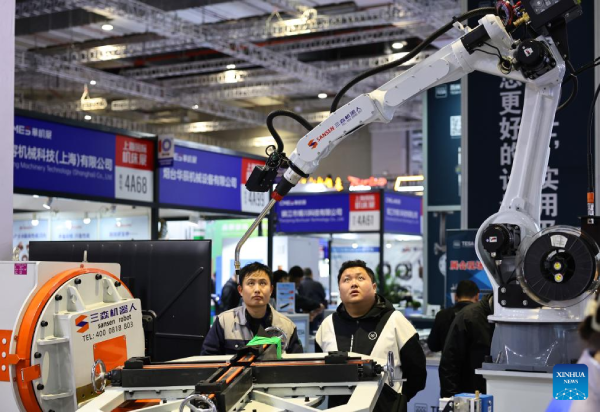
AI is also revolutionizing China’s manufacturing sector. Advanced industrial robots and machine-vision systems are being deployed on factory floors to boost efficiency and precision. At a Shanghai industry expo, for example, intelligent robots demonstrated automated machining solutions for high-demand sectors like new energy vehicles and electronics. Nationally, the market for intelligent manufacturing equipment now exceeds ¥3.2 trillion, and technologies such as AI-driven robotics and digital twin simulations are applied in over 90% of China’s top pilot smart factories. By embracing AI-powered automation, China seeks to upgrade its industrial base and remain competitive as the “world’s factory” in the AI era.
China frequently showcases its AI advances to the public. At the 2024 Digital China Summit, for instance, an AI-powered robotic arm wowed onlookers by skillfully writing traditional Chinese calligraphy with a brush – a vivid example of intelligent automation blending with cultural art. From AI chatbots handling customer service to smart speakers in homes, AI-driven tools are increasingly commonplace in Chinese daily life, reflecting a society that is rapidly embracing intelligent machines and services.
Tech giants and startups alike are propelling China’s AI ambitions. Companies such as Baidu, Alibaba, Tencent, and Huawei have invested heavily in AI R&D – developing everything from large-scale language models and cloud AI services to specialized AI chips and autonomous driving platforms. AI-focused startups like SenseTime (computer vision) and iFlytek (speech recognition) have become leaders in their niches; indeed, China now accounts for an enormous share of AI innovation worldwide, with one analysis finding China-based inventors filed nearly 75% of global AI patents in recent years. This broad ecosystem of firms – often backed by government support – has enabled China to make breakthroughs in areas like facial recognition technology, fintech AI, and intelligent surveillance.
Investment in AI is surging from both public and private sectors. The Chinese government has established large funds and incentives to bolster AI – for example, in 2023 it launched a new ¥300 billion (≈$47.5 billion) national fund to support semiconductor and AI chip development. Major cities offer subsidies and research grants to AI enterprises, while national programs are expanding AI education and training to produce skilled talent. Private tech investment is also robust: Chinese tech giants and venture capital firms pour billions into AI startups, although overall private AI funding in China still trails that of the U.S.. Nevertheless, with abundant data, capital, and strong state backing, China’s AI sector continues to attract massive financial resources focused on innovation.
Despite rapid progress, China faces significant challenges in its quest for AI leadership. One major hurdle is reducing reliance on foreign technology – advanced AI processors and chipmaking tools are still largely imported, and recent export restrictions have made access to cutting-edge semiconductors difficult. This has spurred a push for domestic innovation in chips and basic algorithms, but bridging the gap will take time. Experts note that China still lags global frontrunners in certain foundational areas – from underlying AI algorithms to key software ecosystems – as well as in cultivating top-tier AI research talent. The government is addressing this by expanding AI education and recruiting expertise, but building a world-class innovation ecosystem will be a long-term endeavor. At the same time, China is crafting regulations to ensure responsible AI: from new rules on deepfakes and generative AI content to guidelines on data usage, policymakers must strike a balance between encouraging innovation and mitigating risks like bias or misuse of AI (especially given its extensive use of AI in surveillance). Navigating these challenges will be crucial for China to achieve its AI aspirations.
Looking ahead, China’s advantages – a huge domestic market, vast troves of data, and strong government resolve – position it well in the global AI race. The country’s leadership has reiterated its aim to be the premier global AI innovation center by 2030, and if current trends continue, many analysts believe China could dominate key AI fields. AI is expected to play a pivotal role in China’s future economy, driving everything from smart city infrastructure and autonomous transportation to advanced military systems and scientific research. China is also actively seeking to shape global standards for AI governance, advocating for international cooperation on issues like AI ethics and data security. Ultimately, with sustained investment and careful management of challenges, China’s AI sector is poised to expand rapidly, potentially reshaping industries domestically and solidifying the nation’s status as an AI superpower in the coming decade.